
Want to keep SparkFire at your fingertips? Click the Share Icon and then click "Add to Home Screen" to ADD THIS SITE TO YOUR HOME SCREEN TODAY!
  • Home
  • Portfolio
  • Services
  • Contact
  • Menu
  • The Discovery Shift: Why AI Is Reshaping How Buyers Find Master-Planned Communities

    The Beginning of a New Discovery Era

    For nearly two decades, the digital discovery model for real estate was predictable. Buyers searched Google. They clicked links. They browsed listings. Marketing strategy revolved around SEO rankings, paid search campaigns, and social media exposure.

    That model is now evolving. Buyers are increasingly using AI-powered assistants and generative search tools to ask complex lifestyle questions about where they should live. Rather than returning a list of websites, AI platforms now generate summarized recommendations. This is a profound shift in the discovery layer of real estate marketing.

    Instead of searching: “Homes in Phoenix under 800k”

    Buyers now ask: “What master-planned communities near Phoenix have trails, good schools, and homes under $800k?”


    The Difference Between SEO & GEO

    To understand the shifting landscape of digital marketing, developers and marketers need to grasp two distinct but related concepts: SEO and the emerging practice of GEO.

    SEO — Search Engine Optimization

    SEO is designed to rank pages on search engines. It focuses on elements like keywords, backlinks, page structure, and domain authority, with the ultimate goal of earning a click from the user.

    GEO — Generative Engine Optimization

    GEO takes a different approach. Instead of simply driving clicks to a webpage, it aims to ensure your community is directly referenced or included within AI-generated answers. Generative AI models evaluate factors such as semantic relevance, geographic context, structured data, authoritative content, and trustworthiness. When done effectively, the result is powerful new visibility: your community becomes part of the answer itself.


    Why Master-Planned Communities Are Perfect for AI Discovery

    Master planned communities represent complex lifestyle products, not just homes. Multi-variable lifestyle questions are exactly the kind of questions AI systems are designed to answer. Communities that provide clear, structured information about lifestyle, amenities, and location will be far more likely to appear in these answers.

    Buyers evaluate MPCs based on questions like:

    • Which communities have the best parks and trails?
    • Where are the top school districts?
    • Which areas are growing fastest?
    • What communities offer walkable town centers?

    The Hidden Visibility Gap

    Many community websites were designed for traditional marketing funnels, not AI discovery. To an AI system, this content lacks interpretive clarity. Communities with richer contextual information are far more likely to be surfaced as recommendations.

    Common limitations include:

    • Minimal structured data
    • Generic lifestyle copy
    • Weak geographic context
    • Fragmented amenity descriptions
     

    The Strategic Opportunity

    For developers and marketers, this shift is an opportunity to rethink how communities are presented digitally. It’s no longer just about showing up in search results—it’s about shaping how communities are understood and recommended by AI.

    Forward-thinking organizations aren’t just optimizing for search engines; they’re adapting for AI-driven decision engines by focusing on:

    • AI-readable community data
    • Question-driven content
    • Hyperlocal authority signals
    • Structured information architecture
     

    What Comes Next — Part 2

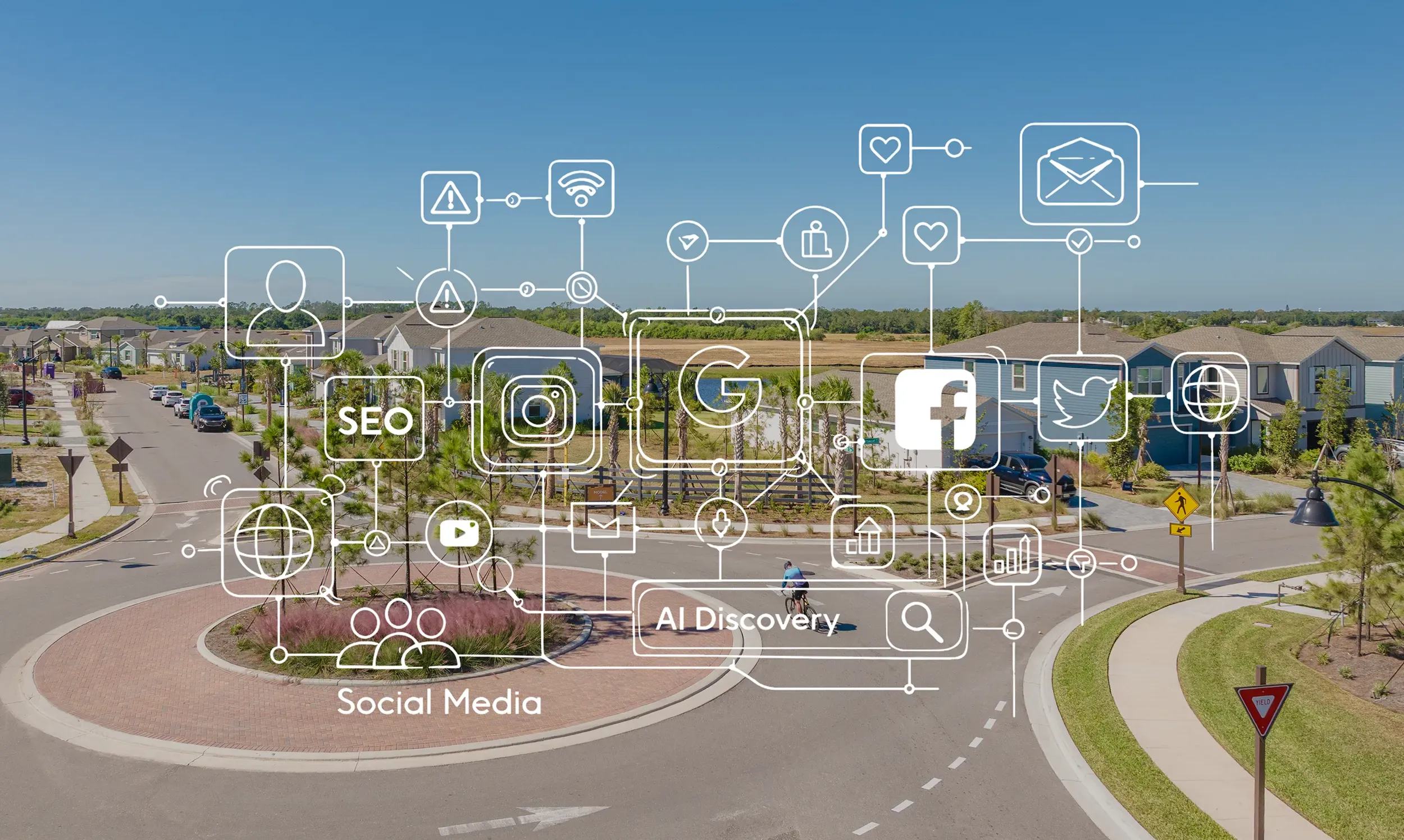
    The future of community marketing won’t be defined by SEO alone—it will be shaped by a broader discovery ecosystem, where each channel plays a distinct role:

    • Search drives research
    • Social drives inspiration
    • AI drives recommendations

    In Part 2 of this series, we explore how these systems combine to create the new marketing stack for master-planned communities.

    Read Part 2

    The New Marketing Stack for Master-Planned Communities

    Marketing Has Entered a New Architecture

    For years, community marketing strategies were built around a familiar digital framework:

    Search → Website → Lead → Sales Center

    Today that journey is becoming far more dynamic. The most effective marketing ecosystems now operate across three interconnected discovery layers. Together, they create a continuous feedback loop of buyer insight and engagement.

    1. Search Platforms
    2. Social Platforms
    3. AI Recommendation Systems


    Layer 1: Search — The Research Layer

    Search engines remain a critical part of the buyer journey.
    They capture high-intent discovery, particularly during the early research phase. SEO (Search Engine Optimization) and paid search campaigns ensure communities appear when buyers begin exploring options.

    Buyers still search for:

    • Homes near top schools
    • New communities in a metro area
    • Best neighborhoods for families
     

    Layer 2: Social — The Lifestyle Layer

    Master-planned communities are inherently lifestyle-driven products. Social platforms offer powerful storytelling opportunities that build emotional connection and motivate buyers to explore further.

    Social platforms are uniquely suited to showcase:

    • Amenities
    • Parks and trails
    • Architecture
    • Retail and dining
    • Community events
     

    The Strategic Advantage of Integration

    When these three layers are integrated, marketing performance improves dramatically. Instead of broad marketing campaigns, communities can operate with precision targeting informed by real buyer behavior.

    AI insights can help marketers:

    • Refine audience targeting
    • Predict buyer intent
    • Personalize content
    • Optimize campaign budgets
     

    What Leading Developers Are Starting to Do

    Forward-thinking developers are aligning data, content, and analytics to strengthen visibility, targeting, and authority—creating a powerful advantage across both traditional search and AI-driven discovery.

    The most forward-thinking developers are beginning to:

    • Structure community data for AI indexing
    • Expand neighborhood and relocation content
    • Connect marketing analytics with CRM data
    • Build authority signals around geography and lifestyle
     

    The Competitive Window

    We are currently in the early stages of AI discovery adoption. That creates a strategic window for developers who act early. Communities that establish strong AI visibility today will benefit from compounding discovery advantages over time.


    What Comes Next — Part 3

    Many marketing teams assume AI optimization requires complex technology investments. In reality, some of the most valuable insights can be uncovered using a simple exercise. In Part 3, we’ll explore how one AI prompt can reveal hidden marketing opportunities for your community.

    The AI Visibility Test: One Simple Exercise Every Community Should Run

    The Question Every Developer Should Ask

    If a homebuyer asked an AI assistant:

    “What are the best master-planned communities near my city?”

    Would your community appear in the answer? Most developers don’t know. Yet this is rapidly becoming one of the most important discovery channels in real estate.


    A Simple Way to Evaluate AI Visibility

    Marketing teams can quickly assess their digital presence by using a simple AI prompt to surface strengths, gaps, and opportunities. For example:

    Analyze our community website for SEO performance, buyer search questions, structured data, and AI discovery readiness.

    This exercise can reveal:

    • Long-tail buyer questions
    • Missing content topics
    • Structural SEO issues
    • Opportunities for AI discoverability
     

    What These Evaluations Often Reveal

    1. Missing Buyer Question Content

    Buyers are already searching with specific, intent-driven questions. If these questions are not answered on your website, AI systems have little reason to reference it.

    • Which communities near Austin have the best schools?
    • What neighborhoods near Tampa have walkable town centers?
    • Where are the fastest-growing suburbs near Nashville?

    2. Limited Structured Data

    AI systems depend on clearly organized, structured information. When this information is structured clearly, it becomes far easier for AI to interpret and recommend. Key data points include:

    • Amenities
    • Home price ranges
    • Builder partners
    • Location context
    • Community features

    3. Generic Lifestyle Messaging

    Many community websites rely on broad, vague language like: “A vibrant community with something for everyone.” However, greater specificity leads to stronger visibility and understanding. AI systems—and buyers—respond better to specifics and favor concrete details, such as:

    • Miles of trails
    • Number of parks
    • Proximity to schools
    • Walkable retail centers
     

    The Strategic Implication

    Communities that clearly structure information and answer real buyer questions are significantly more likely to be discovered, trusted, and recommended across key channels, including:

    • AI-generated answers
    • Search results
    • Relocation research
    • Community comparison tools
     

    The Future of Community Discovery

    The next decade of real estate marketing will likely be defined by AI-assisted discovery. Communities that provide the clearest, most structured digital information will be the ones AI recommends.

    Master-planned communities are more than developments—they are ecosystems of lifestyle, infrastructure, and growth. AI systems are uniquely positioned to interpret and recommend these ecosystems, and the organizations that begin optimizing now will shape how communities are discovered in the years ahead.

    Buyers will increasingly rely on AI to:

    • Compare communities
    • Evaluate lifestyle fit
    • Understand neighborhood growth
    • Assess amenities and schools
     

    How Visible is Your Community in AI Discovery?

    The organizations that optimize today are the ones AI will recommend tomorrow. Our SparkFire team partners with developers and master-planned communities to turn AI into their greatest marketing advantage.

    We evaluate and strengthen:

    • SEO vs. GEO visibility
    • AI discovery readiness
    • Community content strategy
    • Structured data architecture
    • Next-generation marketing strategy